
Utah State University professor Robert Davies calculated that the heat from the completed Stratos AI Datacenter would raise local daytime temperature by five degrees Fahrenheit
and a staggering 28 degrees at night.
Ben Abbott, an ecology professor at Brigham Young University,
warned that these temperature spikes would transform the local environment from semiarid into something more closely resembling the Sahara Desert.
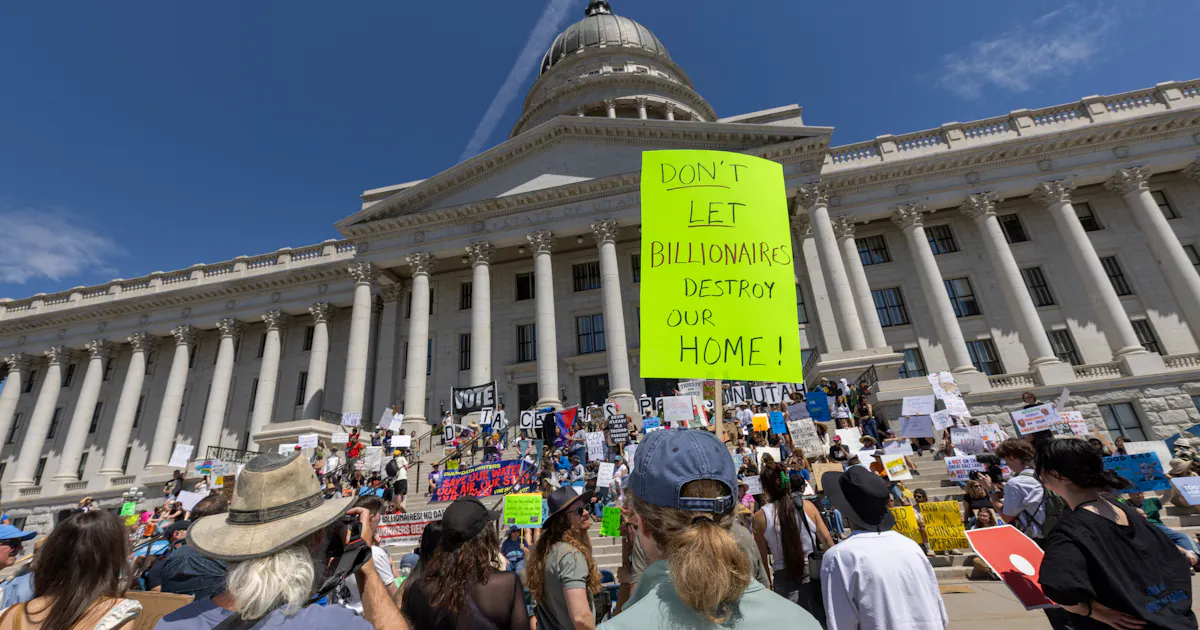
There were also additional concerns that the center would be a massive water draw in a region already prone to drought and facing increasing water shortages.
Despite this, and the complaints of thousands of residents, the project was approved by the Box Elder County Commission in May 2026
—barely two months after it had been announced.
The relative alacrity of their decision-making was partially enabled by the fact that Stratos utilized Utah’s "Military Installation Development Authority", a state entity whose involvement let it bypass ordinary county zoning and the public review such projects normally require
(since the project could theoretically help improve military AI adoption and cybersecurity).
Stratos’s chief backer is Kevin O’Leary, a celebrity billionaire investor better known for his role on the TV show Shark Tank than as an AI infrastructure guru.
He has claimed that Stratos would create 2,000 permanent jobs
(despite the fact that Stratos is yet to have a tenant, and that data centers have historically created far fewer jobs than advocates claim).
But O’Leary’s promises have done nothing to dampen local opposition to Stratos.
In fact, opposition intensified throughout the month of May until Utah Governor Spencer Cox
—who had initially backed the project when O’Leary met with him in January 2026
—signed an executive order on May 29 to ensure that the state properly evaluates data center proposals.
While the Stratos Project was not specifically mentioned in the order,
the timing of the announcement, coupled with the significant statewide pushback to the project,
showed it was clearly an inflection point.
Less than a week later, O’Leary agreed to significantly scale back the proposed data center from 40,000 acres to just over 20,000.
“People are concerned about data centers,” Cox said in a press conference,
“they’re concerned about the lake, they’re concerned about resources, and they should be concerned.”
So, six months after the supposed “industrial marvel” of the Stratos Project was introduced,
the results have been an angry local community,
an embarrassed investor,
and a local state government belatedly searching for a sensible framework with which to govern data center growth.
The backlash has not stopped yet, either.
On June 23, Utah state Senate President J. Stuart Adams,
who was also the chairman of the Utah agency that initially approved Stratos,
lost his Senate seat to a rival who explicitly criticized his support of O’Leary’s project.
https://newrepublic.com/article/212169/stratos-data-center-utah-investors
 The New RepublicThis Data Center Is Everything That Everyone Hates About AIUtah’s Stratos Project is showing how everyone loses in the unregulated rush to build these Big Tech behemoths—even investors.