
These thoughts are important. BASIC and HyperCard were both borderline miraculous in their way — limited, yes, still tricky, yes, but as an entry point, as an invitation? Magical.

My addition to this list: Smalltalk. The lessons of its aspirations and its limitations are as relevant as ever.

1/

beka valentine@beka_valentine@kolektiva.social

what was end user programming like in the 1970s and 1980s?

for the average person, BASIC. by necessity, sometimes, because the software industry wasn't yet distributing as widely, and physical copies were harder to produce, etc.
Jul 2, 2026, 17:09 UTCen

Replying to @inthehands@hachyderm.io

Smalltalk wasn’t just a language; it was a philosophy of the human-computer relationship. At its heart was the idea the computers should be user-malleable: reshapable by each person to be the machine they wanted it to be.

SmallTalk’s impact is hard to overestimate. Most famously, along with CLU and Simula, it gave us objects and OOP — not just in the narrow mid-80s “everything is an object!” sense, but in the broader sense of interface-implementation separation that groups related state and behavior into a tidy abstraction. Its fingerprints are alllll oooover modern programming. But that’s not all.

2/

Replying to @inthehands@hachyderm.io

(SmallTalk legacy cont:) It gave us message passing and late binding, which form the logical backbone of the entire Internet. That idea developed in many places, yes, but SmallTalk was a nexus for it.

The fact the web sites and browsers can be updated independently of each other? that you can visit web sites that didn’t even •exist• when you downloaded your browser? That’s sender-receiver decoupling at work: the Internet is built on messages, and senders and receivers can change independently as long as the message protocol stays intact.

In a far-removed but very real sense, that’s part of SmallTalk’s legacy too!

3/

Replying to @inthehands@hachyderm.io

Still, for all that, there’s a part of SmallTalk — maybe the most important part — that’s kind of lost to time. Part of the original vision was to make every computer something that •the user of the computer could reshape•. Thus SmallTalk’s bizarre-to-us world where there’s no distinction between programming environment and runtime environment: every window on the screen is an object you can modify; every behavior of the system is open to tinkering; every part of the system you’re using a thing you can change.

That vision of the computer as moldable clay looks pretty distant at this point.

4/

Replying to @inthehands@hachyderm.io

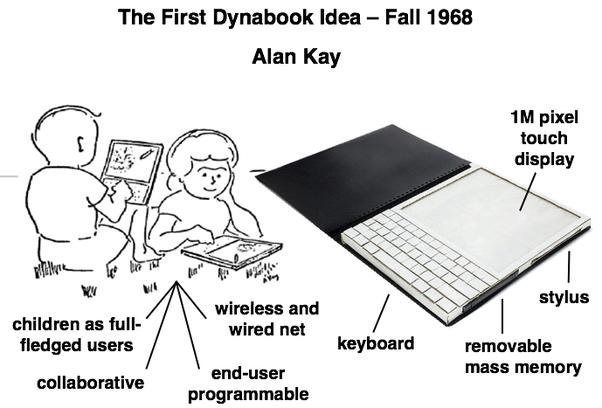
Alan Kay’s original “Dynabook” vision superficially resembles modern laptops and tablets — uncannily resembles in many ways! — but it’s the opposite in one important respect:

Our modern devices are beautifully designed, hermetically sealed products in which there is a strong vendor / user hierarchy.

The Dynabook, as I understand it, would be the opposite of hermetically sealed. It arrives not as a finished design, but as a starting point. Embedded in that “for children” ethos is the idea of play, tinkering, scribbling, making a mess and cleaning it up — and thus the idea of devices being •reshapable•.

(Image source, with lots of commentary from Kay: quora.com/American-computer-pi)

5/

The First Dynabook Idea — Fall 1968. Alan Kay.

Sketch of children using the device, with these labels: children as full-fledge users, collaborative, wireless and wired net, end-user programmable.

Mockup of device, with these labels: 1M pixel touch display, stylus, keyboard, removable mass memory.
ALT