PPlamenu
Sign in
Maddad ☑️@maddad@mastodon.world
1d

George Washington and slavery

https://en.wikipedia.org/wiki/George_Washington_and_slavery

George Washington and slavery Sa 7 languages +
Article Talk Read Edit Viewhistory :
From Wikipedia, the free encyclopedia *
The history of George Washington and slavery reflects Washington's changing atitude EEE
toward the ownership of human beings. The preeminent Founding Father of the United States i Ere 3
and a hereditary slaveowner, Washington became privately regretful about it, but continued le. dia
the practice until his death. Slavery was then a longstanding institution dating back over a ven” TRE » ®
century in Virginia where he lived; it was also longstanding in other American colonies and in | 4 Y A=N zis |
world history. Washington's will immediately freed one of his slaves, and required his | LR =
remaining 123 slaves to serve his wife and be freed no later than her death; they ultimately sis = 2
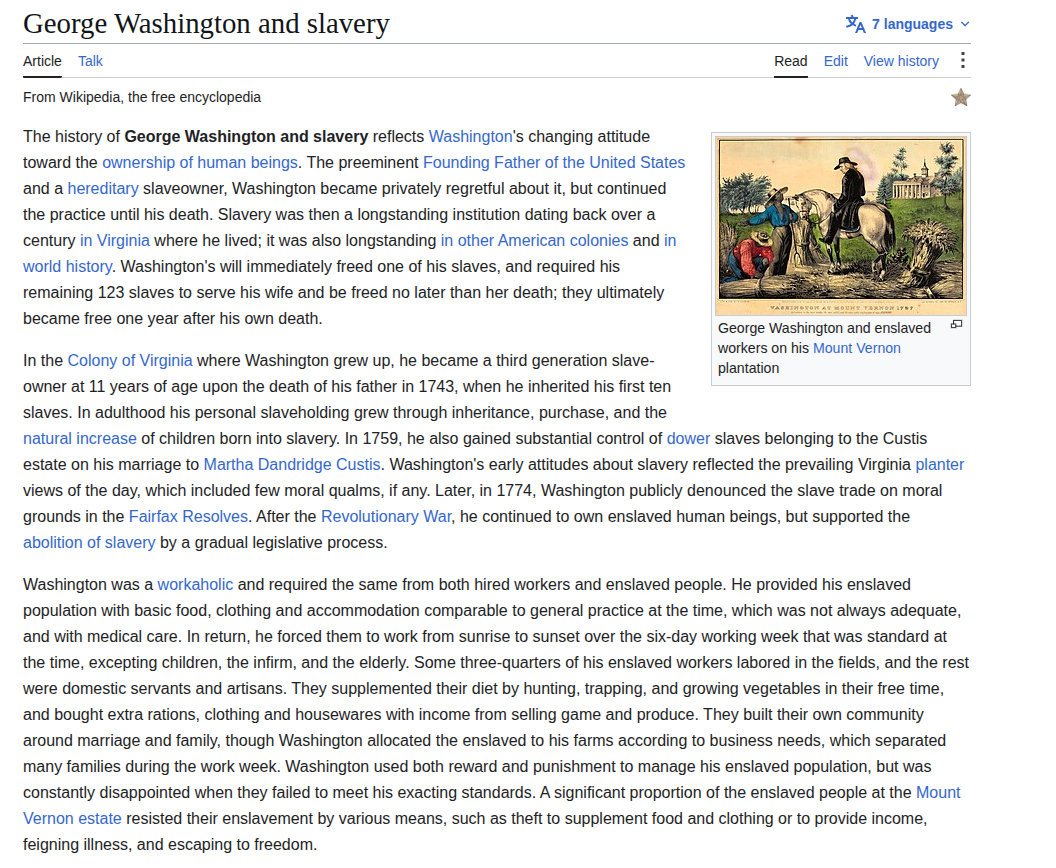
TTT wkemimeve ar segs ransamirer ©
became free one year ater his own death. ree
In the Colony of Virginia where Washington grew up, he became a third generation slave- re his Mount vernon
owner at 11 years of age upon the death of his father in 1743, when he inherited his first ten
slaves. In adulthood his personal slaveholding grew through inheritance, purchase, and the
natural increase of children born into slavery. In 1759, he also gained substantial control of dower slaves belonging to the Custis
estate on his marriage to Martha Dandridge Custis. Washington's early attitudes about slavery reflected the prevailing Virginia planter
Views of the day, which included few moral qualms, if any. Later, in 1774, Washington publicly denounced the slave trade on moral
grounds in the Fairfax Resolves. After the Revolutionary War, he continued to own enslaved human beings, but supported the
abolition of slavery by a gradual legislative process.
Washington was a workaholic and required the same from both hired workers and enslaved people. He provided his enslaved
population with basic food, clothing and accommodation comparable to general practice at the time, which was not always adequate,
and with medical care. In return, he forced them to work from sunrise to sunset over the six-day working week that was standard at
the time, excepting children, the infirm, and the elderly. Some three-quarters of his enslaved workers labored in the fields, and the rest
were domestic servants and artisans. They supplemented their diet by hunting, trapping, and growing vegetables in their free time,
and bought extra rations, clothing and housewares with income from selling game and produce. They built their own community
around marriage and family, though Washington allocated the enslaved to his farms according to business needs, which separated
many families during the work week. Washington used both reward and punishment to manage his enslaved population, but was
constantly disappointed when they failed to meet his exacting standards. A significant proportion of the enslaved people at the Mount
Vernon estate resisted their enslavement by various means, such as theft to supplement food and clothing or to provide income,
feigning illness, and escaping to freedom.
ALT
Jul 4, 2026, 19:22 UTCen
0000
Open original page
BoostsQuotesFavs