When a Country Tells You Who It Is
A Substack Manifesto
By @sirchris
The America You Married
They said she wasn't the country they married. She told them who she was from day one.
CHRIS ÁBRÁHÁM
JUL 03, 2026
There's a piece of relationship advice that gets repeated so often it's turned into a cliché, and like most clichés it's a cliché because it's true: when someone tells you who they are, believe them. It gets said about men mostly, in the context of dating—he told you on the second date he wasn't looking for anything serious, he told you he had a temper, he told you exactly what he was, and you dated him anyway hoping the telling was a bluff, a defense mechanism, a wound you could love out of him. And then, eventually, he does the thing he told you he'd do, and somehow it becomes a referendum on him rather than a confirmation of something you already knew and declined to believe.
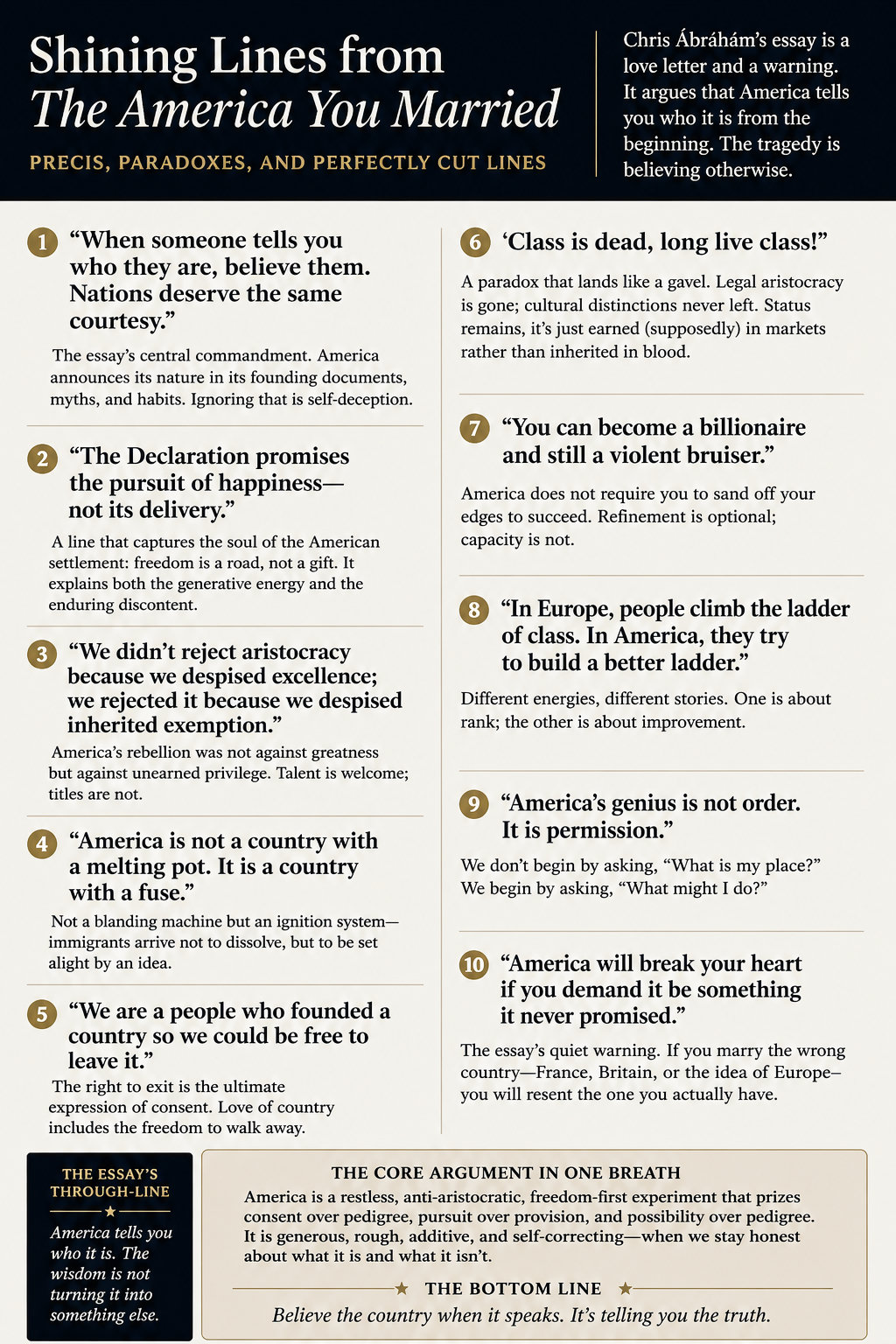
I want to steal that line and point it at the country, because I think America has been telling us who it is since 1776, loudly, in writing, notarized and signed, and a huge portion of the ongoing argument about this place is people refusing to believe the document.
What the founders actually said
The Declaration doesn't promise anyone comfort. It promises unalienable rights to life, liberty, and the pursuit of happiness—pursuit, not arrival, not guarantee. Governments exist to secure that pursuit and derive their power from the consent of the governed. Nowhere in there is a promise of a floor under anyone. Nowhere is a promise of healthcare, or paid sick leave, or a soft landing if your employer's HR department decides not to help you. The founding document is explicit about freedom to act, not freedom from hardship.
That's not an oversight. That's the design. Freedom too, not freedom from. Safety too, not safety from. Protection too, not protection from—protection to defend yourself, to organize, to speak, to worship, to fail and try again, never protection from the basic risks of being alive in the world. The Second Amendment isn't a strange appendix bolted onto an otherwise generous document. It's the most honest sentence in the whole founding, the part where the country tells you outright that it expects you to be able to defend yourself, because it isn't going to do it for you as a matter of course.
I've had this argument myself, recently, in the comments under a Substack post about a Florida teacher who ran out of paid sick days while fighting cancer and had to ask coworkers to donate theirs to cover his treatment. A woman named Cass replied that plenty of countries build in real safety nets, and the United States simply doesn't. She's right, and I told her so, in my own way: America was designed not to be one of those countries. It has no interest in becoming one. I lived in Germany for years and was genuinely appalled by how much trust Germans placed in their government, their employers, their neighbors—people talking about working at Siemens the way an American talks about their college. It didn't make sense to me, because it isn't how we're built. Suspicion of government isn't a bug that crept into the American psyche over time. It's original equipment. It's why the Second Amendment exists at all.
So when Cass and people like Marta, who commented under the same post that the country doesn't give a damn about anyone but the rich, say the system failed them—I don't think they're wrong about the facts. I think they're describing exactly what the country told them it was, before it did it to them. The lawyer image applies here too: the modern activist instinct is to speak on behalf of the people this system genuinely fails, passionately, at length, without ever quite getting around to naming that the system was built this way on purpose and would need to be a fundamentally different country to be otherwise. You can spend your whole political life being someone's furious advocate without ever putting the actual document on the stand and asking it what it said it would do.
The malaise problem
This isn't new, and it's always played out in the same role. Jimmy Carter stood up in 1979 and told the country, in effect, that it wasn't the man he thought he'd married—a crisis of confidence, a spiritual failure, a nation that had lost its way and needed to be fundamentally remade before it deserved celebration. That's the wife's speech, not the husband's. It's the voice of someone sitting the country down and saying this isn't what I signed up for, and the country didn't respond with the tears and self-improvement she was hoping for. It responded by electing Ronald Reagan in a landslide the following year, because a huge number of ordinary people recognized that speech for what it was: contempt dressed as concern, the same way you'd recognize it if your spouse sat you down and told you that you'd never really been who she thought she married.
Barack Obama gave the same speech, updated, decades later—correctly diagnosing plenty of real problems, but doing it in the same voice, the aggrieved-wife voice, the country isn't what I was promised voice. And the backlash to that diagnosis, the sense among a huge swath of the country that they were being lectured and remade rather than represented, is a meaningful part of how Donald Trump happened. Neither Carter nor Obama seemed to clock the shape of what they were repeating. It's the oldest complaint in a bad marriage: I loved who I thought you were, not who you actually are, and now I'm going to spend years trying to renovate you into the man I originally imagined. Nobody wants to be somebody's project. The country doesn't either. And the country had told her, from the very beginning, exactly who he was—she just decided not to believe it until the ceremony was already over.
The number that explains everything
Here's the statistic that makes sense of the entire argument: only 29 percent of Democrats say they're extremely or very proud to be American, against more than 90 percent of Republicans, according to NBC News polling. Other pollsters land in different places—Gallup has Democratic pride at a new low near 14 percent, NPR/Marist puts a broader "proud" category closer to 45 percent—but every version of the number tells the same story. This isn't a rounding error or a single bad poll. It's a durable, years-long collapse in one half of the country's willingness to say, plainly, that they love the place.
That's not a mood. That's the whole disorder in one figure. You cannot build patriotic feeling in a population that's been taught for a generation that pride is naive at best and complicity at worst. You cannot ask someone to celebrate a country they've been told, in college, in the paper, in the culture they consume, is fundamentally a hateful project wearing a flag. The malaise Carter named in a speech, the malaise that helped elect Reagan and then, decades later, Trump, isn't abstract anymore. It's a measured number, and it's concentrated almost entirely on one side of the aisle, which tells you the problem was never America. It was what one half of the country decided to believe about it.
What tourists keep discovering
Something is happening on the ground right now that the "broken country" narrative doesn't have a great answer for. The 2026 World Cup has brought millions of visitors from Scotland, England, Germany, Japan, dozens of countries whose media diet has spent years telling them America is racist, sexist, gun-obsessed, white supremacist, a place they should be afraid to walk around in. And then they arrive, and they have the actual, first-person experience instead of the secondhand one, and it is the opposite of what they were told.
They aren't staying in stadium-adjacent hotel districts either. They're renting F-150s and driving across state lines. They're eating at Waffle House at two in the morning in towns that never see a tour bus. They're in the "flyover" states and the red counties they were told hardest to fear, and coming back with videos of grocery stores the size of airports, strangers who talk to them in line, the friendliest receptions in the exact places they were warned off from. Some of them are apologizing on camera, sincerely, for believing the story their own newspapers and ours sold them.
This is not one curated broadcast or a handful of actors hired to be kind on camera. It's millions of independent, unscripted encounters—a visitor from Leeds buying gas in Alabama, a family from Osaka asking for directions in Dallas, none of them coordinated, none of them paid, most of them not even aware they're being filmed. You cannot stage that at scale. What's being disproven, directly, by people with no reason to lie about it, is the specific claim that this is a hateful, white supremacist country hostile to outsiders. Millions of unrelated strangers with no script and no motive to lie keep independently arriving at the same surprised conclusion, and that conclusion is not the one two decades of domestic activism promised them they'd reach.
I don't think most of the world has earned what this country offers, and I don't say that as an insult to anyone—I say it because being left alone, mostly, by your own government is not a small thing. It is not a deficiency to be corrected. It's closer to a mitzvah, a blessing you didn't have to do anything to deserve, and most places on earth do not extend that to their own people. I'm a free speech absolutist. I'm a single-issue voter on the Second Amendment, and I don't apologize for either position, because both of them are just the same founding logic stated out loud: the government's job is to leave you alone and let you defend the fact that it does.
What the institutions need you to believe
Here is the part that actually makes me angry, on the anniversary of a document I think is close to perfect: there are institutions in this country whose funding, relevance, and headcount depend on racism and white nationalism remaining a live, urgent, expanding threat. Not because the threat doesn't exist anywhere—it does, at the margins, like it does everywhere on earth—but because an organization built to fight a fire has no reason to ever announce the fire is mostly out. The incentive isn't to solve the problem. It's to keep the problem large enough to justify the next budget cycle. That's not a conspiracy theory, it's just how institutions work, and it's exactly why the loudest domestic voices telling you America is a hateful, hopeless, white-supremacist project so rarely update in the face of a hundred million people showing up and finding the opposite.
The popular media and the cultural elite of this country have managed something remarkable: they've taken the crucifix, a symbol of the most literal self-sacrifice a religion has ever offered the world, and set it equal to a swastika—not at the fringes, not as one incident, but as a successful perception, exported and absorbed across the rest of the world. Not adjacent to. Equal to. Christianity is fascism, God is fascism, Jesus is a white supremacist—that's the equation now understood as common sense in rooms that used to know better, in code as plain as x equals y.
The same equation has been getting written under the Star of David for a while now too—campus protests with swastikas spray-painted over it, "Zionist" and "Nazi" used as interchangeable slurs, the oldest hatred in the world laundered through a new vocabulary so it can be shouted at a rally instead of whispered at a dinner table. It's the same move on a different symbol: take the thing a people built out of survival and grief, and rebrand it as the very evil it survived.
Part of how that project works is by quietly swapping American Christianity for a costume nobody's actually wearing. The imagined Christian America in that framing is Mayflower stock, generations deep, old pews and older money—and actual Mayflower descendants are vanishingly rare and, when you meet one, will usually mention it faster than a Harvard grad mentions Harvard. That's not who's filling the churches. American Christianity today is a Nigerian Pentecostal congregation in Houston, a Salvadoran Catholic parish in Los Angeles, a Filipino family two pews from a Vietnamese one, a Black church that's been the backbone of its neighborhood since before anyone in it could vote. Painting the crucifix as a symbol of some narrow, ancestral, white American power structure isn't just cynical. It's factually backwards about who's actually wearing the cross.
I believe in the Constitution as it was written, not as a rough draft waiting for someone to finally get it right. I believe in the Electoral College. I believe the First Amendment protects the church from the state, not the other way around—separation of church and state was written to keep government out of the pulpit, not to scrub the public square of belief. I believe in originalism, in a Supreme Court that interprets the document instead of authoring a new one every generation, in the idea that you get what the Constitution actually says, not what you wish it said. This country does not need to be dismantled and rebuilt on the Danish model. It is not a failed experiment. It is the most successful one in human history, and every college campus that graduates another cohort trained to hate it without ever having lived anywhere else is producing exactly the malaise Carter tried to name in 1979, except now it starts at nineteen years old instead of in the Oval Office.
What nobody's counting
There's a number that belongs in this conversation and rarely comes up: something like $685 billion moves out of countries like the United States each year, back to families in Guatemala, Mexico, India, Bangladesh, the Philippines, more than global foreign aid and foreign direct investment combined. In El Salvador and Honduras that money is over a fifth of the entire national economy. It goes overwhelmingly to the people the old hierarchies back home were built to exclude—not the landed, Spanish-descended elite, but the families sending a son or a daughter to clean offices or drive for an app in a country that never promised them healthcare either.
Whatever this country is or isn't, whatever it failed to design into its own social contract, it apparently still generates enough opportunity, even at the bottom, that people from every corner of the world choose to come here and route money back home rather than the other way around. That's not proof the system is fair. It's evidence that even the unfair version of it is functioning as a magnet, which is its own kind of answer to the "nobody wants to live here once they know the truth" argument.
Believe it
So here's the reframe, on the actual anniversary: America told you who it is a very long time ago, in a document every schoolchild reads and most adults forget. It told you it would secure your right to pursue happiness, not hand it to you. It told you government would be small and suspect by design. It told you, in the amendment right after the one protecting your speech, that you'd better be able to protect yourself, because the institution wasn't going to promise to do it for you as a matter of course.
You can spend your whole life angry that the man never became the man you wanted him to be. Or you can do the thing the dating advice tells you to do the first time, instead of the fifth: believe him when he tells you who he is, decide from there whether that's a relationship you want, and stop being surprised every single year when he turns out to be exactly what he said.
Happy birthday, America. You've been telling us the truth the entire time. It's not our forgiveness you need. It's our attention.
A Substack Manifesto
By @sirchris
The America You Married
They said she wasn't the country they married. She told them who she was from day one.
CHRIS ÁBRÁHÁM
JUL 03, 2026
There's a piece of relationship advice that gets repeated so often it's turned into a cliché, and like most clichés it's a cliché because it's true: when someone tells you who they are, believe them. It gets said about men mostly, in the context of dating—he told you on the second date he wasn't looking for anything serious, he told you he had a temper, he told you exactly what he was, and you dated him anyway hoping the telling was a bluff, a defense mechanism, a wound you could love out of him. And then, eventually, he does the thing he told you he'd do, and somehow it becomes a referendum on him rather than a confirmation of something you already knew and declined to believe.
I want to steal that line and point it at the country, because I think America has been telling us who it is since 1776, loudly, in writing, notarized and signed, and a huge portion of the ongoing argument about this place is people refusing to believe the document.
What the founders actually said
The Declaration doesn't promise anyone comfort. It promises unalienable rights to life, liberty, and the pursuit of happiness—pursuit, not arrival, not guarantee. Governments exist to secure that pursuit and derive their power from the consent of the governed. Nowhere in there is a promise of a floor under anyone. Nowhere is a promise of healthcare, or paid sick leave, or a soft landing if your employer's HR department decides not to help you. The founding document is explicit about freedom to act, not freedom from hardship.
That's not an oversight. That's the design. Freedom too, not freedom from. Safety too, not safety from. Protection too, not protection from—protection to defend yourself, to organize, to speak, to worship, to fail and try again, never protection from the basic risks of being alive in the world. The Second Amendment isn't a strange appendix bolted onto an otherwise generous document. It's the most honest sentence in the whole founding, the part where the country tells you outright that it expects you to be able to defend yourself, because it isn't going to do it for you as a matter of course.
I've had this argument myself, recently, in the comments under a Substack post about a Florida teacher who ran out of paid sick days while fighting cancer and had to ask coworkers to donate theirs to cover his treatment. A woman named Cass replied that plenty of countries build in real safety nets, and the United States simply doesn't. She's right, and I told her so, in my own way: America was designed not to be one of those countries. It has no interest in becoming one. I lived in Germany for years and was genuinely appalled by how much trust Germans placed in their government, their employers, their neighbors—people talking about working at Siemens the way an American talks about their college. It didn't make sense to me, because it isn't how we're built. Suspicion of government isn't a bug that crept into the American psyche over time. It's original equipment. It's why the Second Amendment exists at all.
So when Cass and people like Marta, who commented under the same post that the country doesn't give a damn about anyone but the rich, say the system failed them—I don't think they're wrong about the facts. I think they're describing exactly what the country told them it was, before it did it to them. The lawyer image applies here too: the modern activist instinct is to speak on behalf of the people this system genuinely fails, passionately, at length, without ever quite getting around to naming that the system was built this way on purpose and would need to be a fundamentally different country to be otherwise. You can spend your whole political life being someone's furious advocate without ever putting the actual document on the stand and asking it what it said it would do.
The malaise problem
This isn't new, and it's always played out in the same role. Jimmy Carter stood up in 1979 and told the country, in effect, that it wasn't the man he thought he'd married—a crisis of confidence, a spiritual failure, a nation that had lost its way and needed to be fundamentally remade before it deserved celebration. That's the wife's speech, not the husband's. It's the voice of someone sitting the country down and saying this isn't what I signed up for, and the country didn't respond with the tears and self-improvement she was hoping for. It responded by electing Ronald Reagan in a landslide the following year, because a huge number of ordinary people recognized that speech for what it was: contempt dressed as concern, the same way you'd recognize it if your spouse sat you down and told you that you'd never really been who she thought she married.
Barack Obama gave the same speech, updated, decades later—correctly diagnosing plenty of real problems, but doing it in the same voice, the aggrieved-wife voice, the country isn't what I was promised voice. And the backlash to that diagnosis, the sense among a huge swath of the country that they were being lectured and remade rather than represented, is a meaningful part of how Donald Trump happened. Neither Carter nor Obama seemed to clock the shape of what they were repeating. It's the oldest complaint in a bad marriage: I loved who I thought you were, not who you actually are, and now I'm going to spend years trying to renovate you into the man I originally imagined. Nobody wants to be somebody's project. The country doesn't either. And the country had told her, from the very beginning, exactly who he was—she just decided not to believe it until the ceremony was already over.
The number that explains everything
Here's the statistic that makes sense of the entire argument: only 29 percent of Democrats say they're extremely or very proud to be American, against more than 90 percent of Republicans, according to NBC News polling. Other pollsters land in different places—Gallup has Democratic pride at a new low near 14 percent, NPR/Marist puts a broader "proud" category closer to 45 percent—but every version of the number tells the same story. This isn't a rounding error or a single bad poll. It's a durable, years-long collapse in one half of the country's willingness to say, plainly, that they love the place.
That's not a mood. That's the whole disorder in one figure. You cannot build patriotic feeling in a population that's been taught for a generation that pride is naive at best and complicity at worst. You cannot ask someone to celebrate a country they've been told, in college, in the paper, in the culture they consume, is fundamentally a hateful project wearing a flag. The malaise Carter named in a speech, the malaise that helped elect Reagan and then, decades later, Trump, isn't abstract anymore. It's a measured number, and it's concentrated almost entirely on one side of the aisle, which tells you the problem was never America. It was what one half of the country decided to believe about it.
What tourists keep discovering
Something is happening on the ground right now that the "broken country" narrative doesn't have a great answer for. The 2026 World Cup has brought millions of visitors from Scotland, England, Germany, Japan, dozens of countries whose media diet has spent years telling them America is racist, sexist, gun-obsessed, white supremacist, a place they should be afraid to walk around in. And then they arrive, and they have the actual, first-person experience instead of the secondhand one, and it is the opposite of what they were told.
They aren't staying in stadium-adjacent hotel districts either. They're renting F-150s and driving across state lines. They're eating at Waffle House at two in the morning in towns that never see a tour bus. They're in the "flyover" states and the red counties they were told hardest to fear, and coming back with videos of grocery stores the size of airports, strangers who talk to them in line, the friendliest receptions in the exact places they were warned off from. Some of them are apologizing on camera, sincerely, for believing the story their own newspapers and ours sold them.
This is not one curated broadcast or a handful of actors hired to be kind on camera. It's millions of independent, unscripted encounters—a visitor from Leeds buying gas in Alabama, a family from Osaka asking for directions in Dallas, none of them coordinated, none of them paid, most of them not even aware they're being filmed. You cannot stage that at scale. What's being disproven, directly, by people with no reason to lie about it, is the specific claim that this is a hateful, white supremacist country hostile to outsiders. Millions of unrelated strangers with no script and no motive to lie keep independently arriving at the same surprised conclusion, and that conclusion is not the one two decades of domestic activism promised them they'd reach.
I don't think most of the world has earned what this country offers, and I don't say that as an insult to anyone—I say it because being left alone, mostly, by your own government is not a small thing. It is not a deficiency to be corrected. It's closer to a mitzvah, a blessing you didn't have to do anything to deserve, and most places on earth do not extend that to their own people. I'm a free speech absolutist. I'm a single-issue voter on the Second Amendment, and I don't apologize for either position, because both of them are just the same founding logic stated out loud: the government's job is to leave you alone and let you defend the fact that it does.
What the institutions need you to believe
Here is the part that actually makes me angry, on the anniversary of a document I think is close to perfect: there are institutions in this country whose funding, relevance, and headcount depend on racism and white nationalism remaining a live, urgent, expanding threat. Not because the threat doesn't exist anywhere—it does, at the margins, like it does everywhere on earth—but because an organization built to fight a fire has no reason to ever announce the fire is mostly out. The incentive isn't to solve the problem. It's to keep the problem large enough to justify the next budget cycle. That's not a conspiracy theory, it's just how institutions work, and it's exactly why the loudest domestic voices telling you America is a hateful, hopeless, white-supremacist project so rarely update in the face of a hundred million people showing up and finding the opposite.
The popular media and the cultural elite of this country have managed something remarkable: they've taken the crucifix, a symbol of the most literal self-sacrifice a religion has ever offered the world, and set it equal to a swastika—not at the fringes, not as one incident, but as a successful perception, exported and absorbed across the rest of the world. Not adjacent to. Equal to. Christianity is fascism, God is fascism, Jesus is a white supremacist—that's the equation now understood as common sense in rooms that used to know better, in code as plain as x equals y.
The same equation has been getting written under the Star of David for a while now too—campus protests with swastikas spray-painted over it, "Zionist" and "Nazi" used as interchangeable slurs, the oldest hatred in the world laundered through a new vocabulary so it can be shouted at a rally instead of whispered at a dinner table. It's the same move on a different symbol: take the thing a people built out of survival and grief, and rebrand it as the very evil it survived.
Part of how that project works is by quietly swapping American Christianity for a costume nobody's actually wearing. The imagined Christian America in that framing is Mayflower stock, generations deep, old pews and older money—and actual Mayflower descendants are vanishingly rare and, when you meet one, will usually mention it faster than a Harvard grad mentions Harvard. That's not who's filling the churches. American Christianity today is a Nigerian Pentecostal congregation in Houston, a Salvadoran Catholic parish in Los Angeles, a Filipino family two pews from a Vietnamese one, a Black church that's been the backbone of its neighborhood since before anyone in it could vote. Painting the crucifix as a symbol of some narrow, ancestral, white American power structure isn't just cynical. It's factually backwards about who's actually wearing the cross.
I believe in the Constitution as it was written, not as a rough draft waiting for someone to finally get it right. I believe in the Electoral College. I believe the First Amendment protects the church from the state, not the other way around—separation of church and state was written to keep government out of the pulpit, not to scrub the public square of belief. I believe in originalism, in a Supreme Court that interprets the document instead of authoring a new one every generation, in the idea that you get what the Constitution actually says, not what you wish it said. This country does not need to be dismantled and rebuilt on the Danish model. It is not a failed experiment. It is the most successful one in human history, and every college campus that graduates another cohort trained to hate it without ever having lived anywhere else is producing exactly the malaise Carter tried to name in 1979, except now it starts at nineteen years old instead of in the Oval Office.
What nobody's counting
There's a number that belongs in this conversation and rarely comes up: something like $685 billion moves out of countries like the United States each year, back to families in Guatemala, Mexico, India, Bangladesh, the Philippines, more than global foreign aid and foreign direct investment combined. In El Salvador and Honduras that money is over a fifth of the entire national economy. It goes overwhelmingly to the people the old hierarchies back home were built to exclude—not the landed, Spanish-descended elite, but the families sending a son or a daughter to clean offices or drive for an app in a country that never promised them healthcare either.
Whatever this country is or isn't, whatever it failed to design into its own social contract, it apparently still generates enough opportunity, even at the bottom, that people from every corner of the world choose to come here and route money back home rather than the other way around. That's not proof the system is fair. It's evidence that even the unfair version of it is functioning as a magnet, which is its own kind of answer to the "nobody wants to live here once they know the truth" argument.
Believe it
So here's the reframe, on the actual anniversary: America told you who it is a very long time ago, in a document every schoolchild reads and most adults forget. It told you it would secure your right to pursue happiness, not hand it to you. It told you government would be small and suspect by design. It told you, in the amendment right after the one protecting your speech, that you'd better be able to protect yourself, because the institution wasn't going to promise to do it for you as a matter of course.
You can spend your whole life angry that the man never became the man you wanted him to be. Or you can do the thing the dating advice tells you to do the first time, instead of the fifth: believe him when he tells you who he is, decide from there whether that's a relationship you want, and stop being surprised every single year when he turns out to be exactly what he said.
Happy birthday, America. You've been telling us the truth the entire time. It's not our forgiveness you need. It's our attention.