Although I listen to music for hours every day I'm embarrassingly devoid of knowledge when it comes to how it is made, time signatures, keys etc. And this. What are the implications of doing this? #harp
ALT
Although I listen to music for hours every day I'm embarrassingly devoid of knowledge when it comes to how it is made, time signatures, keys etc. And this. What are the implications of doing this? #harp
Replying to @Gaolaitch@cupoftea.social
@bytebro @keefeglise Oops forgot my bona fides: I am a professional music editor, have edited a fair amount of harp music.

Replying to @keefeglise@mastodonapp.uk
"I am not a harp player"(!) but my guess would be a very different playing technique, but when mastered, probably brilliant for jazz or other 'less structured' music!
You do realise BTW, that 'somewhere on the Fedi' there will be a harp player going "oo, oo, I know!"
Replying to @bytebro@mastodonapp.uk
@bytebro Well I did use the tag! But what's a chromatic note?
Replying to @keefeglise@mastodonapp.uk
@keefeglise @bytebro Jargon, innit. Chromatic means all the piano notes (black and white keys), as opposed to ‘diatonic’ which is only the seven white key notes = (for example) a major scale, and almost all folk tunes and nursery songs.
Replying to @keefeglise@mastodonapp.uk
Forgive me if I'm 'teaching granny to suck eggs' here, but you did ask!
Normal scale starts at a root, and progresses through some full tones and some semitones (white and black keys on a keyboard?) for the octave, so in the key of C as an example, it's all 'white notes', seven of them.
A chromatic scale is *all* semitones, so imagine running the scale on a keyboard, but playing *every note*, whether white or black. There are 12 to an octave.
Replying to @bytebro@mastodonapp.uk
@bytebro Thanks!
Replying to @bytebro@mastodonapp.uk
@bytebro @keefeglise Very quick explanation based on what I think is meant by that description:
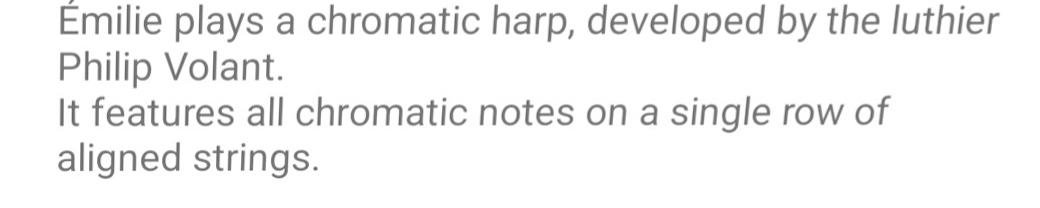
A chromatic harp has a separate string for each possible note on a piano (12 notes per octave). A normal pedal harp has 7 strings per octave, and the pedals allow each string to be changed in pitch up and down one semitone (= to the neighbouring keys either side on a piano). This means there is some overlap of pitches.
This pedalling system restricts a little bit what notes the harp can play all at once, and means the player must use both feet constantly to change the pitches of strings as required by the music. All that goes away on the chromatic harp. No feet required.
Replying to @Gaolaitch@cupoftea.social
@Gaolaitch @bytebro So the reason for using a chromatic harp is that it allows access to combinations of notes not possible on the traditional instrument?
Replying to @keefeglise@mastodonapp.uk
@keefeglise @bytebro Yeah. The more dense the harmonies, the more restrictive it is. You can’t do a chromatic scale* at any sort of speed on the pedal harp, for instance
* all keys on piano in order up or down
Replying to @keefeglise@mastodonapp.uk
I'd guess that ona normal harp, those combinations would likely require pedal-work which may or not be possible. A truly chromatic harp would presumably make all the combinations available, but not necessarily easy to play!
Replying to @bytebro@mastodonapp.uk
@bytebro @keefeglise Yes that’s right. In the Romantic era (big orchestras, complex music) composers would typically write for two harps so they could share out the notes in a way that made them possible (each using different pedal settings).
Replying to @Gaolaitch@cupoftea.social
Yay, I learned a thing. Thank you Jody!
Replying to @bytebro@mastodonapp.uk
@bytebro @keefeglise My pleasure, glad I could help.
Replying to @bytebro@mastodonapp.uk
@bytebro @Gaolaitch Likewise. Thanks to you both.
Replying to @Gaolaitch@cupoftea.social
@Gaolaitch @bytebro Ah. All is clear. I did not know harps had pedals!
Replying to @keefeglise@mastodonapp.uk
@keefeglise @bytebro Not all harps! I spared you that. The modern classical harp used in all orchestral music and solo classical playing does. It’s a 19thC invention I think.